

 Current Families


 Inquire
 Visit
Visit Give
Give








- Our School
- Our Advantage
- Admission
- Elementary•Middle School
- High School
- Summer
- Giving
- Parent Resources
- For Educators
- Alumni
Why Cursive Matters
December 16th, 2025


Why Cursive Matters:
A Powerful Tool for Students With Learning Differences
The Benefits of Cursive Writing for Students—Especially Those With Learning Differences
It seems like everyone has an opinion about cursive handwriting. For some, it’s an outdated skill with little relevance. For others, it’s a valuable art form worthy of dedicated instructional time. Wherever you fall on that spectrum, a growing body of research supports the use of cursive.
As a language arts department head and teacher, I’ve worked with hundreds of students, and most find cursive genuinely helpful. Each September, part of our language arts assessment asks students to write both lowercase and uppercase cursive letters. This allows us to determine who’s ready for direct instruction, who needs review, and who can already use cursive independently. At our elementary and middle school campus, we maintain an internal spreadsheet that identifies whether a student is in the instructional phase, the hybrid stage, or the full implementation stage.
Why go to all this trouble?
Increased Writing Efficiency
One of the biggest advantages of cursive—especially for students with language-based learning differences—is the efficiency it provides. Because cursive requires fewer pencil lifts, students can get their ideas onto the page more fluidly.
Writing is a multi-step cognitive process. Thoughts originate in the brain, move through language pathways, become verbal, and then must be translated into written form. Print writing often disrupts this flow with frequent starts and stops. Efficient and automatic handwriting supports cognitive flow. For many students, cursive offers a motor pattern that becomes efficient more quickly.
As Steve Graham notes in his article Want to Improve Children’s Writing? Don’t Neglect Their Handwriting, “The basic goal of handwriting instruction is to help students develop legible writing that can be produced quickly with little conscious attention.”(Graham, 2009-2010, p. 23) For students with learning disabilities, cursive supports this goal.
Reduced Letter Confusion
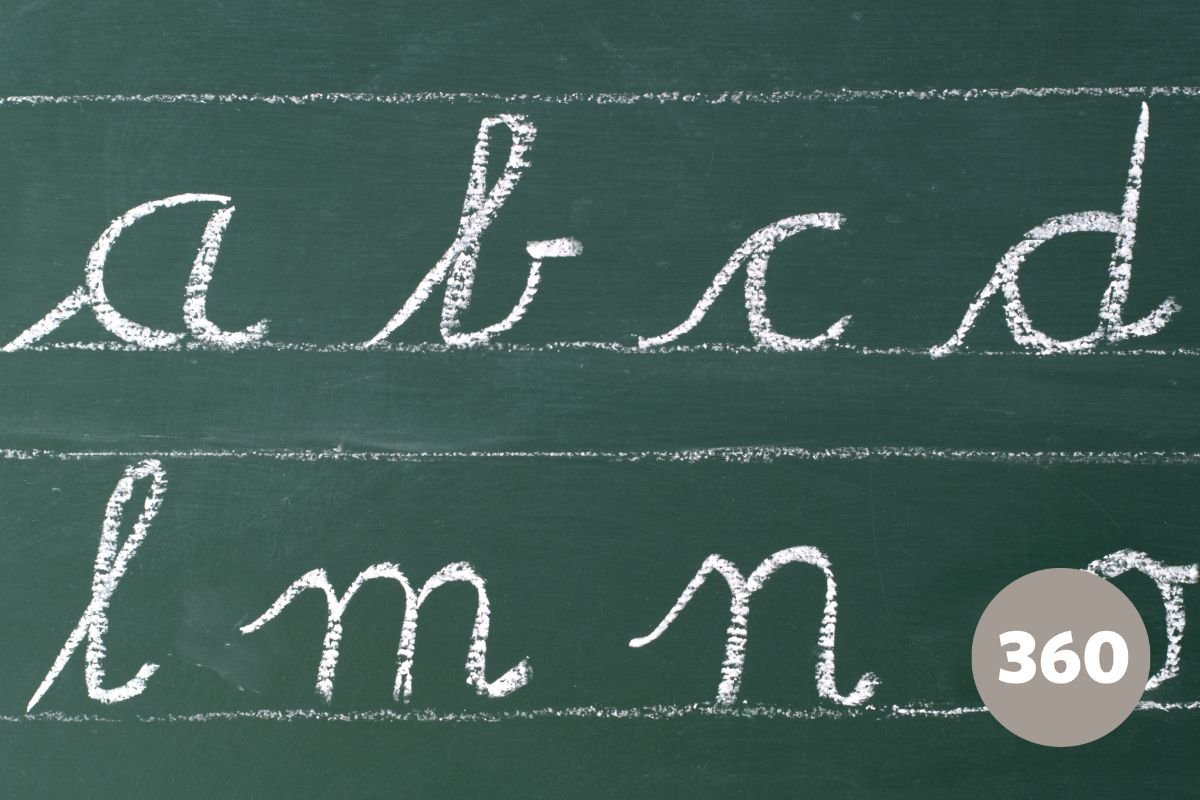
Cursive also offers visual and kinesthetic benefits. Many letters that are commonly confused in print—such as b/d, w/m, and n/u—have distinct and contrasting forms in cursive. For students who struggle with print reversals, cursive provides an alternative path that minimizes confusion.
In cursive, lowercase letters consistently begin with an upward stroke from the baseline. This predictable starting point reduces the likelihood of reversals and reinforces correct letter formation through muscle memory.
A Confidence Boost
Perhaps most importantly, cursive can be a significant confidence builder for students with language-based learning differences. In my experience, it’s an “easy win” for many learners. With regular practice, they can master cursive skills and incorporate them into their everyday writing.
When students who struggle with print see and feel their success with cursive, they often experience a genuine sense of pride—something that can be rare for children who find writing challenging.
Empowering Students With Dyslexia
Students with dyslexia often face a range of writing-related challenges, including difficulties with efficiency, spelling, letter reversals, and maintaining neatness. Learning and using cursive gives these students a way to take control of some of these difficulties. It offers a practical tool that improves writing while also providing a new skill that can be implemented meaningfully and confidently.
Resource
Graham, S. (2009–2010, Winter). Want to improve children’s writing? Don’t neglect their handwriting. American Educator. Want to Improve Children's Writing? Don't Neglect Their Handwriting by Steve Graham, American Educator Winter 2009-10, A
About the Author
Geoff Russell MSEd. has taught at Landmark School since 2007. He is currently the Chair of the language arts department at the elementary-middle school campus and teaches 7th- and 8th-grade classes.

Posted in the category Learning Disabilities.